Dear , Welcome to this edition of "To Be Clear..."- a refreshing sip of regular coaching clarity in your inbox. With Christmas Day (at least on the
Gregorian calendar), less than a week away, this final full edition of the year offers you a couple of brief ideas and insights for deeper clarity at work (and beyond) as many of you down tools for a well deserved break.
As Christmas approaches, with the purchase of gifts, tickets and food, many of us have had to think about budgets, whether on how much we have to spend on people we love or what we can get for £10 in our workplace "Secret Santa". Perhaps calendar year end is also your financial year end and so you have had to think about budgets at work or in your business. However, there is a currency many of us need to think about carefully at this time of year but, because it isn't easily visible on our bank balance or cashflow spreadsheets, it can be easy to overlook. That vital currency is energy. No doubt, as we rush to finish a list of tasks at work before the break while simultaneously getting ready to host or head off to Christmas with family and friends, many of us have said or heard multiple times, "I am so tired". That cry is understandable and is a reminder that we have a finite amount of fuel left in our engine. The fact is that, when you are aware that you have a finite amount of something valuable left, be it time, money or - in this case - energy, you need to be smart about how you spend it. C.S.Lewis, the bestselling children's and adult book author, philosopher, Christian theologian and all round great 20th century thinker and writer, once wrote, "It is a very funny thing that the sleepier you are, the longer you take about getting to bed."* And so it is with energy, if we are not careful, the less we have of it, the less clear we get about what matters and so the more we squander it on things that don't matter. Weariness
and a lack of energy can sap our clarity at work just when we need it most. At this point of the year, many of my clients come to me pretty spent when it comes to energy. At those times, I've found that it helps to think about energy as currency, as something
they need to budget and spend carefully while they replenish it wisely. In the short term, while energy is in short supply, here are a couple of ways to spend it carefully: 1) It might help to spend your limited energy on what's small and manageable rather than what's huge and requires the best of you (the latter can wait until your stores of energy are better replenished). The same way, you know you can't afford a cashmere coat if you only have £10 but you can start intentionally saving up for it and buy something within budget which will keep you warm in the meantime, try to
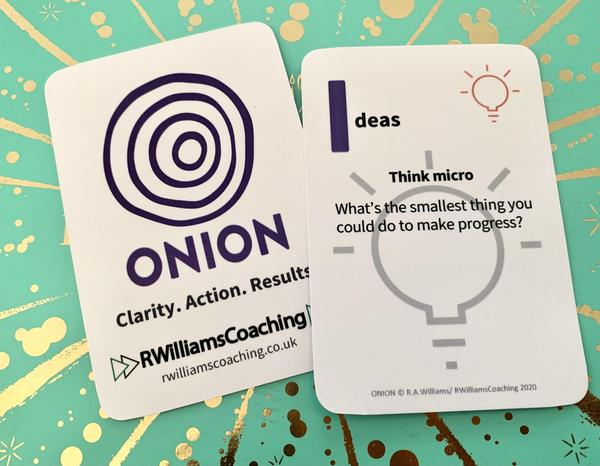
spend limited energy intentionally on smaller "purchases". In terms of the value of small steps and also knowing your emotional runway (which is often highly correlated with your levels of energy), this previous edition of "To Be Clear..." may be helpful on the topic as might this classic question from the Ideas layer of both
ONION® and Digital ONION®:
2) When your energy supply is particularly limited, it is sometimes helpful to spend your limited energy on what's urgent rather than on what's important. This might feel counterintuitive so let me give you an example. A client came to
me recently, bemoaning not completing on a huge initiative by year end; when gently probed, it became clear there was no reason it had to be done by year end and the client was better off focussing on doing it well rather than doing it quickly. In the interim, there were a bunch of smaller, less flashy things that would benefit from being done soon and could be done by year end and the client has decided to focus on those and return to the more important project in the new year when
hopefully they'll have more energy in their account. 3) Finally, when your energy supply is limited, it often helps to spend a little of that limited energy on something you enjoy or which comes relatively easy! It is a weird fact that depleted energy often
makes us masochists focussed on the hardest, most miserable objectives. But this creates a vicious circle which stops us from starting or gets us stuck from the off. Is there a task on that list which will give you satisfaction or pleasure to do? Start there. The second article in this previous issue of "To Be Clear..." which focusses on the practical value of joy might be a help to you. As you head into the Christmas break, you might also want to think about where you focus your energy when it comes to the people in your life; giving and receiving the gift of presence in manageable but meaningful ways is often a way of gaining greater clarity both at work and in your wider life. So, in the flurry and exhaustion, why not pause today or tomorrow and get out your phone or a piece of paper and on one side write a rough to-do list (you don't have to write every single item, you can group similar things) and then under it write, "Where can I best spend my limited energy in
the coming couple of weeks?" You might ask, "What's urgent?" (ie. absolutely has to be done within this specific timeframe) and also "What might actually be better tackled in the new year?" as well as "With what can I ask for help?" and "Where's the low hanging fruit?" ie. small, achievable tasks that help you make incremental progress and are easily ticked off the list.
Taking five or ten minutes of your no doubt precious time to get some clarity here will reap dividends for you both in the coming two weeks and as we enter a new year. In terms of replenishing your funds of energy, this very popular previous edition of "To Be Clear..." has a bit to say on the topic. Next up, a highly underrated skill that will transform your clarity and effectiveness at work (and beyond!) in the coming weeks and the coming year.
This time of year is very much a time of giving and receiving - gifts, cards, delicious food. When it comes to work, both giving and receiving have their place and pleasures but we often forget that in between the two often lies a key skill which many of us are less good at - the skill of Asking
Well. As I review another year of coaching, it has struck me how much of my work is about helping my clients to Ask Well - to ask clearly, boldly, appropriately, for what they want and need at work - be that new roles, better terms from investors or employers, more
clarity on expectations, more support, more responsibility, new ways of working. We often associate asking with being demanding or, still worse, entitled but actually Asking Well is part of deeper clarity and more effectiveness at work not just for you but for those with
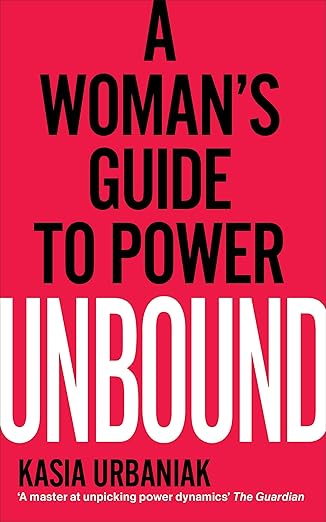
whom you work. Kasia Urbaniak in her excellent and thought provoking book, Unbound, puts it like this: "We're all asking for things all the time, often without explicitly stating our opinions and desires..." And she is right, there are things we all want and need more or less of at work. Not asking does not make those things go away, they simply lie under the surface seeping into our working relationships, causing unnecessary friction or strain. Urbaniak points out that "Asking simply takes all those hidden requests and cues and makes them explicit by
putting them into language." Yes, you say, but we all know those annoying, demanding people who are always asking for something, we don't want to be like them, constantly making it all about themselves - entitled and infuriating. And you're right, you don't. And that's where
Asking Well comes in. Asking as an act of generosity rather than demand.
When it comes to Asking Well, Urbaniak writes something which I have worked hard at helping my clients - both male and female but especially female - to see and then to act on to great success. "Every time you ask someone for something, you are offering them a role in your
life." It's worth pausing and thinking about that again, "Every time you ask someone for something, you are offering them a role in your life." That's the key to Asking Well. When we Ask Well, we are engaging in a relationally rich act, we are offering the person we ask a gift. Jesus, as always, explains this brilliantly when he illustrates the abundantly generous character of God by using the lovely and very familiar analogy of human parents and their children to show how much human beings love to give when asked in
the right circumstances: “Which of you fathers, if your son asks for a fish, will give him a snake instead?
Or if he asks for an egg, will give him a scorpion? If you then, though you are evil, know how to give good gifts to your children, how much more will your Father in heaven give the Holy Spirit to those who ask him!”
Perhaps unsurprisingly, this analogy follows some of Jesus's most well-known words, "So, I say to you: ask and it shall be given to you..." The fact is anything worth doing cannot be achieved on your own or in a vacuum, it tends to involve other people and so being intentional about how you involve other people is key. I explored the topic in a previous piece on the value of asking for help. When it comes to ONION®, knowing who and for what to ask is a key part of the Now layer. Most of all, helping my clients learn how to Ask Well in a
way that is congruent with who they are and their desired Outcomes is a key part of my coaching practice. I had a wonderful client, working in a senior role at a world renowned organisation, who in our introductory conversation complained that her line manager wasn't
giving her what she wanted. "Well, what do you want?" I asked. She couldn't give me an answer and so I gently pointed out that if she didn't know, it was very hard for her boss to guess let alone give it to her! She got the point - that she was complaining in lieu of doing the
hard work of working out what she actually wanted. Once she had grasped this, one of the great joys of working with her was that she not only got deeper clarity on her desired Outcomes, but she learned how to ask for them in a way which meant her organisation was only too happy to give them to her. This led to a much more fulfilling role for her, massively increased satisfaction for her at work and much benefit for her organisation. Colleagues actually commented not just
on her improved results at work but on how differently she was showing up at meetings. She felt the difference as well, telling me that learning how Ask Well had restored her sense of agency. Another client running a scaling business came to me saying how much he wished that his investors would use more appropriate metrics for the businesses' growth. I asked him to outline his proposed new metrics and the rationale for them to me;
he did a great job and then I simply said, "It sounds like these metrics would serve both the business and your investors much better." He nodded and I continued, "What would stop you asking them to use them?" He paused, smiled and said, "Nothing!" By the time we
next met, he had Asked Well, his investors had agreed to his Ask, the new metrics were in place and it was a joy to see that business grow and to coach the CEO and the team as they went on to achieve a very healthy exit the following year. One tech company leadership team I was coaching was up against
it, low on funding runway, investor confidence and even lower on morale and so I asked them as part of a team coaching session to take a few minutes to consider what they most needed from the other members of the leadership team and then to ask for it. Sounds simple doesn't it? But many of them had never articulated their Asks in this way before. That session led to significant breakthroughs including huge progress on the development of a new product, surfacing of some key risks and a leadership team member telling me afterwards that he had been ready to throw in the towel but now had hope for the future of the business. That tech business went on to achieve an excellent exit in a tricky market and their acquirer specifically mentioned the quality
and combined value of the leadership team as a key factor in the acquisition.
Urbaniak writes presciently that where relationships have got stuck or stale, "The right ask can get the energy moving again." In each of my client examples above, clear and well offered Asks not only blessed both the Asker and the Giver but they made all the difference in re-energising and transforming key
working relationships leading to better results all round.
As all of my clients above learned, learning how to Ask Well is deeply worthwhile but requires you to do the hard work of looking in the mirror and clarifying what you really want. That's why rather than asking, we often complain (out loud or internally),
equivocate, try and take the whole burden on ourselves, hope others will simply read our minds and then find ourselves (unfairly) disappointed in them when they don't. Clarifying our Asks and Asking Well is one area in which working with a coach who gently challenges you can be helpful and, to that end, it's not too late to book an ONION® Clarity Session for the new year to get you clearer on your aims and Asks
in 2026. I still have limited December availability for these one-off, specially priced sessions. If you're thinking about it, and would like to find out more while still a couple of places available, feel free to drop me an email
with "Clarity Session" as your subject header. Whether or not you work with a coach, when it comes to learning to Ask Well, you can definitely make a start on your own. As we hit the heart of the festive season, as you give and receive gifts, why not start to work on your Asks by
asking yourself a couple of questions: "What do I want and need more of at work in the coming year?" And then "What do I need to ask, who do I need to ask, how can I ask in a way which is generous and offers something to them?" If you're struggling to answer that first question, ask yourself an even more challenging one, "Where have I found myself complaining most when it comes to work in recent months?" or "What have I been finding most frustrating at work?" You may be able to find your key Asks
there. More on this topic of Asking Well and on Kasia Urbaniak's excellent book in the new year. So there you have it; two key end of year insights for deeper clarity at work and beyond - spend your limited energy like currency and learn to Ask Well. Both hopefully useful to reflect on and even to start practising in the coming weeks as you prepare to begin 2026. As always, I'd love to hear how you are putting these insights into practice so do get in touch. I'll try and send a brief Christmas message out next week and I'll be back in the new year with more ideas and insights for
greater clarity at work but, in the meantime, wishing you a clearer week ahead and a wonderful Christmas break.
*-From The Silver Chair - the sixth in C.S. Lewis's classic Chronicles of Narnia series.
|
|
|
|
|
|
|