Happy (almost) lunar New Year of the Horse! Welcome to this edition of "To Be Clear..." - a refreshing sip of regular coaching clarity in your inbox. On a logistical note, you might notice that a new year brings
"To Be Clear..." to you from a new email address (rw@rwilliamscoaching.co.uk) which should ensure more reliable delivery. Nothing else has changed but please
do add this new address to your contacts and, if you haven't received any of the last few editions, do check your spam folder. Hopefully, your 2026 is beginning to settle into some sort of rhythm and this first edition of the year offers you a couple of ideas and insights for deeper
clarity at work for the coming weeks and also the coming year.
A few weeks ago, I met with a client - a highly accomplished leader who is in the process of founding a new venture for his organisation and who had just finished appointing the last member of his new leadership team. As we discussed what it was going to look like to enable and equip this new team going forward, it struck me what a great way this was to start the year - not writing a strategy or resolutions or endless to-do lists but picking and prioritising the key people who were going to be instrumental to
his success at work in the coming year. A few days later, I watched a TV show on Disney+ called Chad Powers, about a washed up American football player who gets a second chance on the field after blowing up his career in a
humiliating, very public way.* In the show, the job of the fictional team coach (played very well by Steve Zahn) feels more akin to a theatre director casting a play than to sport. He doesn't simply pick the strongest, fastest players but ensures that each position in the team is
matched to the man with the right character for that role. And then when he finds those players, he invests deeply in them and building the right relationships with them. It struck me that, for all of my clients, whether they're building a business or a team or
their own career, a key part of deeper clarity and greater effectiveness at work comes from picking the right "team". By picking their "team", I don't mean simply the colleagues with whom they work most closely but the people and relationships they want to
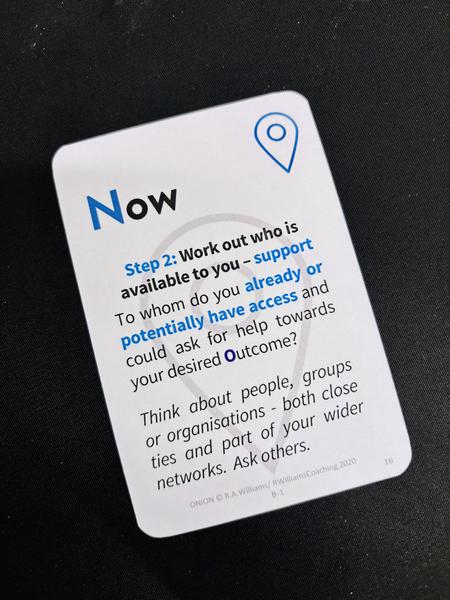
prioritise and invest in, in order to achieve greater clarity and improved Outcomes at work. Nothing meaningful is ever achieved alone - team work really does make the dream work - it's why ONION® includes the involvement of others (whether for objectivity or accountability or ideas) and the Now layer of ONION® includes questions like this:
I think of one client seeking to progress to a senior role but feeling stuck in a rut with his very senior line manager. Together, we worked out ways for him to build his own broader "team" both within and outside of the business who could support and
enable his career progression. In his case, that looked like intentionally choosing and investing in five key internal and external relationships. The result was that my client gained a refreshed outlook and sense of agency, an improved relationship with his line
manager and a new far more senior role for himself. I also think of one organisational client striving to bring about unprecedented strategic change in a divided, fragmented context full of complex politics. Key to creating and delivering on that strategic change was gathering and coaching a new seven-person strategic team from across the organisation specifically to work on this project. We picked a team with diverse perspectives and priorities but all ready to build and get behind a new vision. Three years on, even though that ad hoc "team" has
disbanded, the strategy that they helped create is still delivering amazing tangible returns for the organisation including growth in revenue, people and results. What about you? Who would you like to have on your "team" this year when it comes to developing greater
clarity and effectiveness at work?
It might help to start by thinking about where you'd like to be work-wise (and more widely) this time next year. What would be different? And then to ask, "What kind of people would I need on my "team" to enable that
change?" I would suggest aiming for a five person "team"**. You don't have to fully staff your "team" right now. Like any good sports coach or manager, you can start with one or two foundational team members and then do some scouting and build
from there. The people in your "team", don't have to know each other and they don't have to work alongside you every day or even in the same business as you but they do need to have the potential to play a meaningful role in your clarity and development at
work. Your "team" might comprise family, friends, current or ex-colleagues or people from other professional or social networks. It might include people you pay for support (at home or at work) alongside those you don't - either way, try and mix it
up.
This isn't about being transactional or thinking of people who can do you one-off favours; it is about building structures of mutual support, encouragement and generosity to help you get clear and get to where you want to be in the coming
year(s). Choose people you like and trust and with whom you feel some affinity and measure of reciprocity. Choose people who will challenge and encourage you and keep you
accountable. Choose people who bring complementary perspectives and skills, with whom you can be honest and who you respect. Most of all, choose people who you feel are fundamentally for you, who back you and are interested in your success and who you back and can serve in some way. Some questions you might ask of everyone you consider, "What makes this person a great pick for my "team"? Followed by "What role would I like them to play?" (It might be partner, collaborator, encourager, mentor, mentee, support in very specific area or something else) and "What role might I be able to play for them?" and finally, "What's the next step in
developing this relationship?" To give you an example from my work, having my own coach, Kristen Freeman, on my team over the last few years has been a game changer in terms of my clarity and effectiveness at work. Kristen's and her business partner, Rachel's, very successful coaching business is called Clarity on Fire and the clarity and vision - as well as
capacity to execute - that Kristen's brilliant and highly practical support, encouragement and expertise has brought me at work is both measurable and invaluable. I am so glad and privileged to have her on my "team". The next step is to continue working with her! Why not consider
what it looks like to create your own "team" for 2026 and let me know how it goes?
Next up, an idea and corresponding approach that have the potential to accelerate your clarity and effectiveness at work (and beyond) in significant ways.
Much of my work is with founders and scaling businesses, all of whom are very aware of their "burn rate" - the rate at which they are "burning" or getting through the cash they have - also known as a business's runway. As I and my co-founder build our own new venture around Digital ONION® in a rapidly developing market, a key metric for us is "learn rate" - the rate at
which we learn from our experiments and deploy the lessons we learn.
I used to have a sign above my desk that read: "Let's make better mistakes tomorrow". It's a bit of a truism that, in order to grow, make progress and achieve success, you have to try new things or, at least, do old things in new ways.
Remember, as we've previously explored, clarity and action are close
bedfellows - we only get clearer on more effective paths forward as we try things and then learn from them. One thing
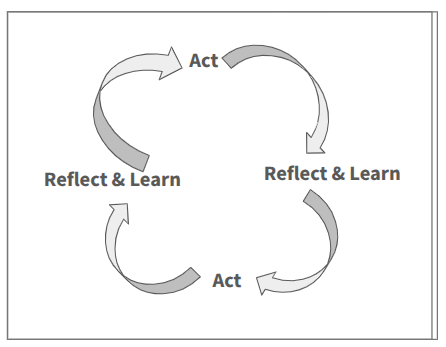
that holds people back from trying new things is a fear of failure. But, in reality, as Felix Danczak says in his brilliant book, Market Led Growth, "...failure is not the problem - failure without learning is the problem..." Many of my clients have talked about how working with me provides the space and opportunity to consider and develop new approaches and then to rapidly try them out at work and learn from them. They point out that it is precisely this intentional, iterative loop of action and learning which has led to them achieving success with their desired Outcomes. This learning loop has led my clients to
progress to new roles, build new products, ventures, teams and businesses in highly successul and often surprising ways.
Ultimately, deeper clarity and real success come not from burying, endlessly ruminating on or forgetting failures and frustrations but from leveraging the lessons you learn from them as quickly as
possible. By definition, not everything you try will work and that is fine, even good, as long as you learn from it and - crucially - learn fast. Building a highly efficient learning loop which leads to increased clarity, progress and success means ensuring that the distance between learning and informed action gets shorter and shorter.
Felix Danczak describes this as "learning velocity".
Given all the change increasingly affecting every industry and area of work, increasing your learning velocity, as a team, individual or business, will be critical to success. Felix Danczak has even developed a metric - Failure Yield Rate or (FYR)*** - for businesses to measure how quickly they are learning and then deploying what they learn. Some questions it might be helpful to ask, especially if you are feeling stuck or unclear at work are, "What is my failure yield rate?", "How can I measure it?" and "How can I increase it?" These questions work really well
for teams as well, although, if you are doing this work as a team, it's vital that you do it in an atmosphere that operates within a contribution as opposed to a blame framework. See this previous issue of "To Be Clear..." for more on how to do that.
You might be adjusting to or trying new ways of working, you might be developing new products, programmes or processes, you might be trying to change role or lead a new team. If something doesn't go according to plan, or is frustrating or changes unexpectedly, what can you learn from that and - more importantly - how quickly can you put that learning into practice?
What would it look like for you to start to build a more effective learning loop and to increase your learning velocity in the months ahead - perhaps not just for yourself but also for your team?
Why not start by reviewing the year to date and asking: "What hasn't gone as planned/ been a bit disappointing and what have I learned from that?" (Try and write down two or three key things). And then, "Where and how quickly can I apply some or all of those lessons?" (Be specific about the where and how of application, not just "I'll try and be better at..." but "As of next week, I'll commit to [specific different action or approach]..."). Don't wait until next quarter or next year to apply and deploy your learning, remember - your progress and success hinge on your learning velocity or learn rate - so you get points for applying and deploying your learning fast. So there you have it - two ideas to increase your clarity, integrity, progress and success at work in the coming year -
carefully pick and really prize your "dream team" and focus on increasing your learning velocity by building a tight learning loop which puts what you learn into action fast. As always, do get in touch to tell me how you are thinking about and putting these ideas into practice. It's always great to hear from you. I'll be in touch
before long to share more ideas and insights for greater clarity at work as well as some exciting new developments in which you can participate. In the meantime, wishing you a clearer week ahead and a happy Year of the Horse.
*-Think Ted Lasso - a show I used as an illustration in this previous issue of "To Be Clear..." - but goofier and
weirder. ** - If it's good enough for basketball, 5-aside football and unicycle hockey (!) ... *** - Danczak's Failure Yield Rate formula is: FYR = (number of learnings x speed of implementation)/ cost of experiment
|
|
|
|
|
|
|